
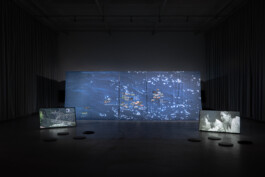
Where Water Remembers (2025–2026) Film stills, 4K UHD, colour, sound, 64’34’’
River Mourns, Island of Ashes (2025–2026) Film stills, 4K UHD, colour, sound, 43’36’’
From the Sea to the River (2025) Research archives printed on linen, stones, 210 × 390 × 130 cm


ENG
Project: Where Water Remembers is an ongoing research-based project that traces the continuities of imperial and colonial violence through the metaphor of water. The project brings together two video works, Where Water Remembers and River Mourns, Island of Ashes, alongside the installation From the Sea to the River. Centring the narratives of Zainichi Korean communities and individuals who cultivated their lives near these waters, the project approaches individual and collective memories intertwined with landscape as embodied archives and forms of testimony.
To investigate how collective trauma and memory are embodied and transmitted across generations, Yun conducted research in eight cities across Japan and interviewed second- to fourth-generation descendants of people who were displaced or migrated under conditions shaped by Japanese imperial violence. The first video, Where Water Remembers, moves through personal and intergenerational memories of migration, gendered labour, family, and practices of care, while attending to what is transmitted through stories as well as through silence and absence.
The second video, River Mourns, Island of Ashes, turns towards practices of mourning at sites marked by colonial and wartime violence, tracing how remembrance extends into present-day forms of solidarity and resistance. Moving through memorials, testimonies, archival traces, and intimate gestures of care, the film considers how histories of violence continue to be remembered and negotiated in the present. Acts such as offering water to the dead become forms of care and remembrance, opening a question that runs through the work: how might solidarity emerge across disparate histories without reducing their differences?
The title Where Water Remembers reflects a geographic and political reality. Many Zainichi Korean communities developed in marginalised areas along riverbanks and canals, distanced from urban centres and near sites of forced labour such as coal mines, factories, airports, and harbours. Yet water operates beyond local geography. It moves between sites and generations, carrying traces of migration, labour, loss, and survival. Rather than treating water simply as a metaphor for memory, the project approaches it as a medium through which memory is carried, mourning is enacted, and histories separated by geography can enter into relation. Through water, the project asks how memories of violence can be reactivated in the present without reproducing the violence they carry.
국문
프로젝트 《물이 기억하는 곳》은 물의 메타포를 따라 제국주의적 폭력과 식민주의의 연속성을 추적하는 리서치 기반의 멀티미디어 프로젝트이다. 프로젝트는 두 편의 영상 작업 《물이 기억하는 곳》과 《애도의 강, 재의 섬》, 그리고 설치 작업 《바다에서 강으로》로 구성된다. 강과 물길 주변에 삶의 터전을 일구어 온 자이니치 코리안 공동체와 개인들의 서사를 중심에 두고, 풍경과 얽힌 개인적·집단적 기억을 ‘체화된 아카이브이자 증언의 형태’로 바라본다.
집단적 트라우마와 기억이 어떻게 몸에 새겨지고 세대를 가로질러 전해지는지를 탐구하기 위해, 작가는 일본의 8개 도시에서 리서치하며 일본 제국주의 폭력 아래 강제 이주되거나 이주할 수밖에 없었던 이들의 2세부터 4세 후손들을 만나 이야기를 들었다. 첫 번째 영상 《물이 기억하는 곳》은 이주와 젠더화된 노동, 가족과 세대 간 기억, 돌봄의 실천을 따라가며, 이야기로 전해지는 것뿐만 아니라 침묵과 부재를 통해 전달되는 기억에도 주목한다.
두 번째 영상 《애도의 강, 재의 섬》은 식민주의와 전쟁 폭력의 흔적이 남은 장소에서 이루어지는 애도와 기억의 실천으로 시선을 옮긴다. 추모비와 증언, 아카이브의 흔적, 그리고 친밀한 돌봄의 행위를 따라가며, 과거를 기억하는 행위가 애도와 연대, 저항을 통해 어떻게 현재로 이어지는지를 추적한다. 죽은 이들에게 물을 건네는 것과 같은 행위는 돌봄과 기억의 실천이 되며, 작업은 이를 통해 서로 다른 역사를 동일한 것으로 환원하지 않으면서도 그 사이에서 어떻게 (공통없는) 연대가 발생할 수 있는지를 질문한다.
프로젝트의 이름 《물이 기억하는 곳》은 하나의 지리적이고 정치적인 현실에서 출발한다. 자이니치 코리안 공동체의 많은 거주지는 일본 사회에서 주변화된 지역, 곧 도심에서 떨어진 강변과 수로를 따라 형성되었으며, 탄광, 공장, 공항, 항만과 같은 강제노동의 장소 인근에 자리하고 있었다. 그러나 이 프로젝트에서 물은 이러한 지역적 지리를 넘어 작동한다. 물은 장소와 세대 사이를 이동하며 이주와 노동, 상실과 생존의 흔적을 운반한다. 따라서 프로젝트는 물을 단순히 기억의 메타포로 바라보는 것을 넘어, 기억이 운반되고 애도가 수행되며 지리적으로 떨어진 역사들이 서로 관계 맺을 수 있게 하는 매개체로 접근한다. 물을 통해 작업은 폭력의 기억을 현재에 다시 불러내면서도, 그 기억이 담고 있는 폭력을 재생산하지 않는 것이 어떻게 가능한지를 질문한다.
Film stills, «Where Water Remembers(2025 - 2026)» and «River Mourns, Island of Ashes (2025 - 2026)»
